HoneyFil Ingredients
The eight ingredients inside every HoneyFil gummy, described one at a time.
Eight ingredients go into every HoneyFil gummy: a pair of essential nutrients, a pair of amino acid compounds and four botanical extracts. Below, each one gets its own entry — origin, role in the formula, and what the category has historically used it for.
Vitamin B3 (Niacin) in HoneyFil
A B vitamin the body uses in the reactions that release energy from food. Water soluble, so it is not stored in quantity and benefits from arriving daily.
Niacin is vitamin B3, one of the eight B vitamins and one of the two ingredients in this formula carrying a recognised daily value. The body puts it to work in the reactions that release usable energy from what you eat.
Because it is water soluble it is not held in reserve, which is part of why a once-daily format suits it. In HoneyFil it anchors the energy-metabolism side of the formula rather than the botanical side.
Zinc (as Zinc Oxide) in HoneyFil
A mineral involved in hundreds of enzyme reactions across the body, and a fixture of men's daily formulas for exactly that reason.
Zinc turns up in men's daily formulas so consistently that its absence would be the surprise. It takes part in hundreds of enzyme reactions, and the body keeps no large store of it.
The form used in HoneyFil is zinc oxide, which the label states plainly. As with every ingredient here, the exact amount is on the Supplement Facts panel of the bottle you receive.
L-Citrulline in HoneyFil
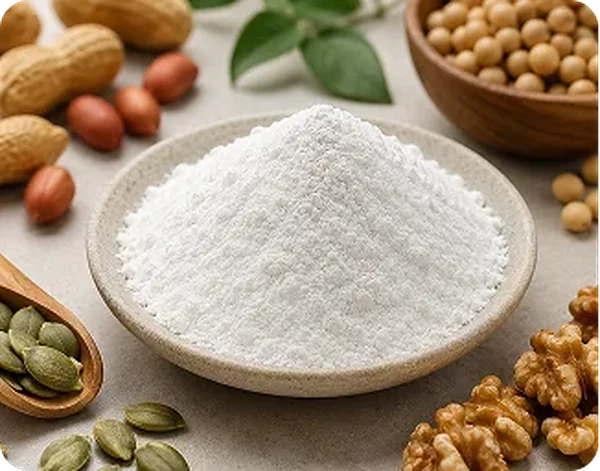
Found naturally in watermelon. The body converts it onward to arginine, the step that ties it to healthy blood flow.
L-citrulline is an amino acid that occurs naturally in watermelon. Once absorbed, the body converts it onward into arginine — the step that connects it to the nitric-oxide pathway and from there to how the circulatory system handles effort.
That conversion is exactly why formulas of this shape reach for citrulline instead of arginine directly. In HoneyFil it carries the circulation half of the stated purpose.
L-Carnitine in HoneyFil
Handles transport inside the cell, carrying long-chain fatty acids into the mitochondria where they are burned for energy.
L-carnitine is a compound the body assembles for itself from two other amino acids, and also takes in from red meat and dairy. Its established job is transport: shuttling long-chain fatty acids into the mitochondria, where they are burned.
That mechanism is where the energy framing in this category comes from. It describes a process rather than promising a feeling, which is the more honest of the two statements.
Pine Bark Extract in HoneyFil
Drawn from maritime pine and standardised for proanthocyanidins, a polyphenol family long carried in circulation formulas.
Pine bark extract comes from the bark of maritime pine and is standardised for proanthocyanidins, a family of polyphenols. It has been a fixture of circulation-oriented formulas for decades.
Extract strength varies considerably between standardisations across the industry, which is one more reason the panel on your own bottle is the reference that counts.
Maca Root Extract in HoneyFil
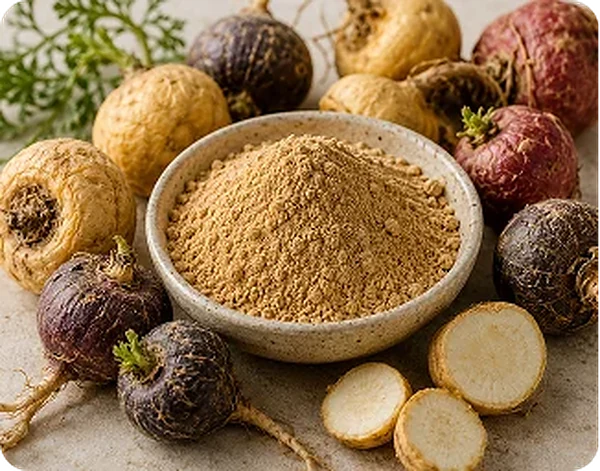
A Peruvian root grown above 4,000 metres and eaten as food there for centuries before it was ever sold as an extract.
Maca is a root vegetable grown above 4,000 metres in the Peruvian Andes. It was food there for centuries before anyone dried, powdered and sold it as an extract, and its traditional association is with stamina and holding up under physical demand.
That is a traditional-use description rather than a clinical finding, and HoneyFil presents it as exactly that.
Grape Skin Extract in HoneyFil
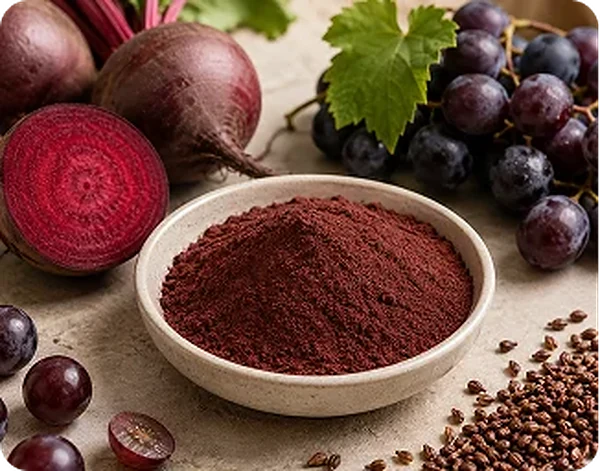
Taken from the skin rather than the juice, which is where the fruit keeps its polyphenols.
Grape skin extract is taken from the skin rather than the juice or the seed. The skin is where the fruit keeps its polyphenols, and it is the reason a red wine is red.
In this formula it sits alongside pine bark as the second polyphenol-bearing entry, on the botanical side of the eight.
Saffron Stigmas Extract in HoneyFil
Hand-picked crocus stigmas, three threads to a flower, and by weight the most costly ingredient in the bottle.
Saffron is the stigma of the crocus flower, picked by hand, three threads to a bloom. By weight it is the most expensive spice in the world and almost certainly the most expensive ingredient in this bottle.
It is also the most recent arrival of the four botanicals here, and the entry that makes this ingredient list less ordinary than most.
Read the HoneyFil panel, not this page
Whatever the Supplement Facts panel prints on the bottle you receive is the live, complete statement of the formula — every ingredient and the exact quantity of each. This page describes; the panel governs. Where the two ever disagree, the panel is right and we would like to hear about it.
What the background above does and does not cover
Each entry describes an ingredient on its own terms. None of it reports on HoneyFil as a finished product, because research on a single compound does not transfer to a formula that happens to contain it. HoneyFil is a dietary supplement and is not intended to diagnose, treat, cure or prevent any disease.
Head back to the formula overview, or read how the eight group together.